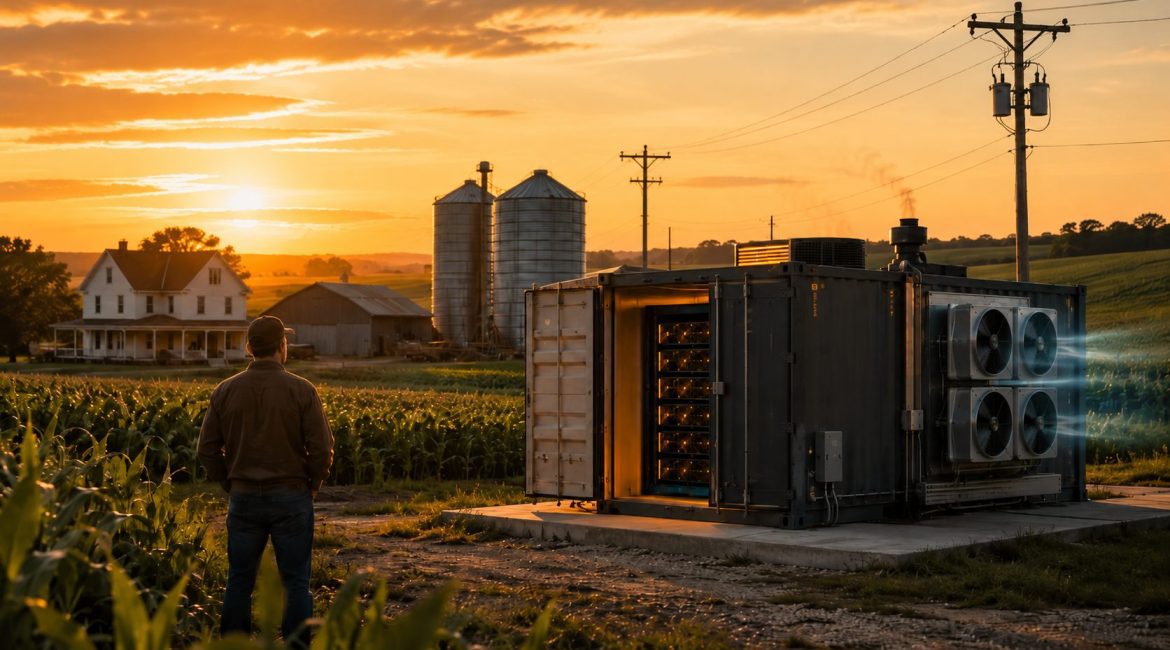
Discover how a farmer leveraged farmland equity to explore new income opportunities and diversification in the tech space.
For generations, farmers and landowners have looked for ways to make their operations stronger.
That may mean trying new crops, adding livestock, pursuing custom work, finding new uses for existing buildings, creating rental income, or identifying other ways to diversify beyond traditional farm revenue.
For one farmer, that mindset led to an unconventional opportunity: expanding a Bitcoin mining operation, with financing secured by farmland equity.
The farm operator, who asked to remain anonymous in this public story, did not begin with a major investment strategy or a large-scale plan.
“It never started as a revenue source. It started as a hobby.”
Like many farmers, the borrower was drawn to the project through curiosity and a desire to understand how things work.
“I have always liked to tinker, build things, and figure out how systems work. That is probably part of being a farmer. One day, I made an impulsive purchase and bought an old, used, inefficient air cooled Bitcoin miner. It was no longer profitable by modern standards, and I think it cost around $100 including shipping.”
The miner went into the garage, where the borrower began learning the practical side of Bitcoin mining.
“I hooked it up in my garage and started learning. I taught myself how mining worked, how the machine connected to the network, how mining pools worked, and how much heat it produced.”
That heat became one of the first practical lessons.
“I was heating my garage with it. At certain times, it felt like I was getting paid to heat my garage instead of just burning propane or electricity with no return.”
What began as a hobby gradually became an opportunity the farmer believed was worth studying more seriously.
Diversification Has Always Been Part of Agriculture
Agriculture already comes with significant variables: weather, commodity prices, input costs, interest rates, equipment expenses, land taxes, and more.
For that reason, diversification is not a new idea for farmers and ranchers. It is often part of building a more durable operation.
This farm operator says, “Farmers and ranchers should always look at alternative revenue sources. That might be different crops, cattle, CRP, custom work, part-time jobs, rental income, or something else entirely.”
The borrower sees Bitcoin mining as one possible example of that kind of diversification, not a replacement for agriculture.
“A more diversified income base makes a farm stronger. Agriculture already has enough risk with weather, commodity prices, input costs, interest rates, equipment costs, and land taxes.”
Bitcoin mining is not a fit for every farm or landowner. It involves power costs, equipment, cooling, networking, repairs, uptime, taxes, financing, and market risk. But this farmer believes some rural properties may have untapped potential worth exploring.
“Bitcoin mining is not right for everyone, but farmland can have a unique advantage. Many farms are located near power infrastructure, especially in areas with wind energy or other power that may be difficult to move long distances because of transmission constraints or economics.”
That perspective broadens the traditional way landowners may view their property’s value.
“The value of farmland is not always just the soil anymore. In some cases, the value may also come from power access, location, infrastructure, and a strong relationship with the local electric cooperative.”
Understanding the Physical Side of Bitcoin Mining
Bitcoin is often discussed in abstract terms: price, markets, trading, and digital assets.
But mining is also a physical process. It requires machines, energy, networking, cooling, maintenance, and infrastructure. The borrower said operating equipment firsthand changed how he viewed Bitcoin.
“One thing people often say is, ‘I cannot touch Bitcoin, so it is not real.’ I understand that argument because I used to think that way too.”
For the borrower, mining made Bitcoin more tangible.
“But once you operate a Bitcoin miner, you see something different. Bitcoin mining is proof of work. It takes real energy to secure the network. That energy produces real heat.”
The operation uses immersion cooling, which helps manage heat generated by mining equipment and significantly reduces the noise typically associated with mining operations.
“If someone says Bitcoin is not real because they cannot touch it, I would invite them to stand next to the cooling towers and feel the heat coming off the mining operation. That heat is real. That power is real. That physical process is part of what secures the Bitcoin network.”
The borrower believes there is a connection between the long-term thinking common in agriculture and the way he views Bitcoin.
“Agriculture and Bitcoin have more in common than people think. They are both tied to commodities, scarcity, energy, patience, and cycles. Farming grows a physical crop. Bitcoin mining produces what some people call a digital crop.”
Energy Access and Rural Opportunity
Energy access is a central consideration for any mining operation.
“Energy access is probably the most important part of Bitcoin mining.”
The borrower believes rural areas may have an opportunity to play a role where local infrastructure, available power, and utility relationships align.
“Nationwide, there is a shortage of reliable energy in many places. At the same time, there can be excess energy in certain local areas, especially where power is being generated but cannot easily be moved somewhere else.”
“That is where rural areas can matter. A family farm may not have enough power for a hyperscale data center, but it may have enough for a meaningful Bitcoin mining operation.”
The borrower also noted that mining operations can potentially be flexible in their power use, depending on the system, infrastructure, and arrangements in place.
“If the cooperative needs power back during a shortage or peak demand period, miners can shut down quickly. That can make mining a useful customer when it is structured correctly.”
Start Small. Learn by Doing.
The farm operator is clear that Bitcoin mining carries risk and should not be approached casually.
“Bitcoin is volatile. Mining is risky. Equipment prices move. Power costs matter. Financing matters. Uptime matters.”
His advice to farmers or landowners who are curious about mining is simple: begin with education and a small-scale experiment.
“Start small.”
“Do not start by buying a large amount of equipment. Buy one old, used air-cooled miner, plug it in safely, and learn. Learn how loud it is. Learn how hot it gets. Learn how much power it uses. Learn how mining pools work. Learn how to connect it to the network. Learn how to tune it.”
The farmer recommends talking with electric cooperatives and utility providers early in the process.
“Then talk to your electric cooperative. Ask about power availability, rates, demand charges, transformer requirements, curtailment options, and whether the local system can support the load.”
He also emphasizes that mining is not simply a matter of purchasing equipment.
“Bitcoin mining is not just buying machines. It is power, heat, networking, cooling, firmware, repairs, financing, taxes, market risk, and uptime.”
For him, the path from hobby to larger opportunity was grounded in learning, testing, and deciding whether the concept justified additional capital.
“Creative ideas do not have to start big. In fact, they probably should not start big. Try something small, make mistakes, learn, and then decide whether it deserves more capital.”
Finding a Lender Willing to Understand the Whole Picture
As the farm operator considered expanding, financing became a key part of the conversation.
“I was looking for a lender that would treat the idea seriously and look at the full picture.”
The farmer said some lenders were not comfortable evaluating a financing request involving Bitcoin mining, even where the proposed transaction involved farmland collateral and an established agricultural operation.
“Some traditional agricultural lenders were not comfortable with the idea of using farmland collateral for something outside normal agricultural purposes. Once Bitcoin came up, the conversation often changed.”
The operator acknowledged that mining carries real risk and requires a thoughtful evaluation.
“Bitcoin mining is risky. I do not deny that. Bitcoin prices move. Mining difficulty changes. Equipment values change. Power costs matter. A bad plan can lose money.”
But he wanted a lender willing to consider the overall credit picture rather than dismiss the request based solely on the industry label.
“The financing hurdle was not just proving that mining could work. It was proving that the whole picture made sense: collateral, power, equipment, liquidity, taxes, risk management, and the long-term plan.”
That is where Conterra became part of the story.
“Conterra was different. They were open-minded. They listened to the agricultural side of the story, the land equity side, and the business plan. They did not dismiss the idea simply because it involved Bitcoin mining.”
The borrower said the financing helped move the expansion forward because Conterra was willing to evaluate the full opportunity.
“Conterra helped by treating me and the project with respect.”
“They were willing to look at the collateral, the plan, the risk, and the long-term opportunity. That mattered because many lenders might stop at the word Bitcoin and never get to the actual numbers.”
“Conterra evaluates each financing request individually, considering the borrower, collateral, repayment capacity, transaction structure, proposed use of proceeds, and applicable underwriting and compliance requirements.”
-Conterra Relationship Manager: Joe Erickson
Innovation Requires Discipline
Conterra’s role in this transaction was to evaluate a specific, borrower-driven financing opportunity. It was not a recommendation of Bitcoin, digital assets, or Bitcoin mining as an investment strategy.
“Conterra is open to innovation and forward thinking, while maintaining credit principles that have been proven over the long run. Our underwriting team evaluates each transaction on its own merits to assess the applicant’s character, current financial position, past performance, forward business plan, and collateral, to tailor a solution that best meets an applicant’s individual needs.”
– Chief Credit Officer: TJ Roemmich
Not every alternative revenue opportunity will be appropriate for every farm, landowner, or lending structure. But this borrower’s story demonstrates how a farmer can look beyond traditional uses of land, study a new opportunity carefully, and seek financing built around the strength of existing assets.
For the borrower, Bitcoin mining is one more tool to consider as part of a broader long-term plan.
“I do not tell farmers to buy Bitcoin. I tell farmers to study Bitcoin.”
For Conterra, the transaction reflects the importance of understanding the complete picture behind a financing request.
Beyond the acres, there may be new opportunities for farmers and landowners willing to study the possibilities, understand the risks, and build responsibly for the future.
This article describes a single borrower’s experience and is provided for general informational purposes only. It is not an offer to lend, a commitment to finance, or an endorsement of Bitcoin, digital assets, or Bitcoin mining. Past financing decisions by Conterra are not indicative of future financing decisions, and Conterra makes no representations with regard to financing similar transactions in the future. Nothing in this article should be considered investment, tax, legal, energy, or operational advice. Any financing opportunity is subject to independent underwriting, credit approval, collateral evaluation, verification of use of proceeds, applicable compliance review, and the terms of definitive loan documentation. Financing availability may vary based on borrower qualifications, transaction structure, applicable law, contractual requirements, and Conterra policy.