
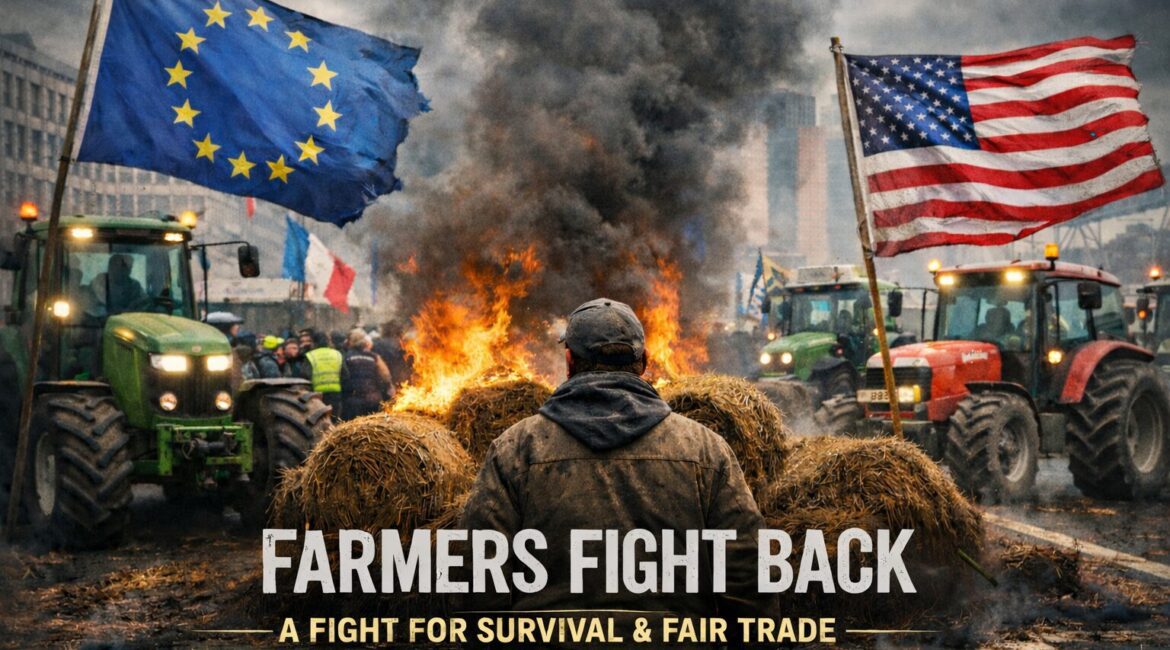
The biggest story you probably haven’t heard about on your mainstream news station. The American media largely ignores the farmer protests happening across the EU.
Right now, farmers across the European Union—especially in France—are taking to the streets, blocking highways with tractors, dumping manure on government buildings and burning tires in downtown Brussels. They are risking arrests, fines and political backlash to make their voices heard. These are not radical protests. These are desperate ones. Why doesn’t anyone know this is happening? The farmers protest in europe is a crucial moment for agricultural policies.
American farmers should be paying close attention. If it can happen there it can happen anywhere. You aren’t getting the story from the mainstream media. You will only find these videos and images from boots on the ground reporting and social media outlets like X. The farmers protest in europe is a wake-up call for all farmers.
Understanding the Farmers Protest in Europe
European farmers are protesting policies that threaten their ability to survive:
- Trade deals that favor cheaper imports produced under looser environmental and labor standards
- Rising regulatory burdens that increase costs without increasing farmgate prices
- Government mandates that disrupt herds, production, and long-term planning
- Climate agenda regulations
- Shrinking margins as input costs rise while commodity prices remain under pressure
Sound familiar?
The European farmer is being squeezed from every direction—by global trade policy, centralized regulation, and financial systems that reward scale and efficiency over stewardship and resilience. Many are being told, implicitly or explicitly, that farming as they’ve known it is no longer viable.
This Is a Warning, Not Just a Protest.
What we’re seeing in Europe isn’t isolated—it could just be a preview of what could come here in America.
Policymakers prioritize global trade efficiency over local food security…when your government does not work for its own people but for a global agenda you get policies that look like this. Regulations are written far from the land by people who’ve never worked it…And farmers are expected to compete against imports that don’t play by the same rules.
The result is always the same: fewer independent farmers, more consolidation, and less resilience in the food system.
American agriculture is not immune.
Farmers Everywhere Are Fighting the Same Battle
Whether you’re raising cattle in Iowa, growing corn in Nebraska, or running a multi-generation operation in France, the struggle is shared:
- Fair pricing for honest work
- Consistent rules applied equally to domestic and imported goods
- The ability to plan for the future without political whiplash
- Inflation and high inputs that erode any chances of profits or growth
- Respect for farmers as essential producers, not environmental villains
European farmers aren’t protesting for special treatment. They’re demanding a level playing field—the same thing American farmers have been asking for decades.
When farmers in Europe push back, it creates friction in systems that affect us all:
- Global commodity pricing
- Trade agreements
- Environmental policy frameworks
- Food security assumptions
Ignoring these protests means missing an opportunity to learn—and to prepare. Farmers across the world are being regulated and inflated to death. The food supply is being consolidated into fewer hands. The EU is making it impossible for smaller farmers to survive.
Farmer protests in Europe did not happen overnight. For years, agricultural producers across multiple countries have organized large-scale demonstrations — including tractor blockades and highly visible public actions — to express concern over mounting economic pressures, regulatory burdens, and trade policies that directly affect their ability to operate sustainably. Despite the scale and persistence of these protests, they have often received limited attention outside of Europe.
This lack of coverage may reflect broader media and policy dynamics, where complex agricultural issues compete with other global priorities and are frequently framed through economic or political narratives rather than the lived realities of farmers. Trade agreements, environmental mandates, and regulatory frameworks are often discussed at a macro level, while their cumulative impact on farm viability receives less scrutiny.
Over time, this disconnect has contributed to growing frustration within rural communities, who feel increasingly removed from decision-making processes that shape their livelihoods. The current wave of protests highlights the consequences of prolonged inattention to these concerns — not as sudden unrest, but as the result of years of unresolved structural pressure on those responsible for food production.
Standing With Those Who Feed the World
From Iowa to France, from the Great Plains to the EU countryside — farmers are facing the same forces: consolidation, bureaucracy, and policies disconnected from reality.
American farmers should see these protests not as foreign news, but as a shared struggle and a warning sign.
When family farmers are forced off the land, and agriculture is consolidated into a handful of producers or state run farms… we will all pay the price.
Disclaimer: The views and opinions expressed in this article are solely those of the author, [BitFarmer], and do not necessarily reflect the views or opinions of Conterra Ag Capital. This article is for informational and entertainment purposes only and should not be construed as financial advice. Readers are encouraged to conduct their own research and consult with a qualified financial advisor before making any investment decisions.
